

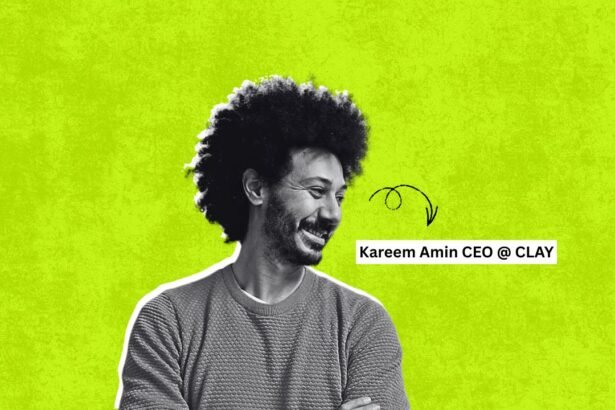
If you are a founder in the Middle East or North Africa (MENA) dreaming of building a “Unicorn,” you’ve probably been told to follow a specific script: raise money, work 24/7, and hope for the best. But Kareem Amin, the Co-Founder and CEO of Clay, just rewrote that script. Clay isn’t just another tech company; it’s a powerhouse valued at over $1.5 billion – with sights set on $10 billion– that is fundamentally changing how businesses grow.
But Kareem’s journey wasn’t a straight line. It was a wild ride of “lost years,” failed experiments, and a deep psychological shift that every founder needs to hear. Here is the deep dive into the mind of Clay’s CEO, the journey of the startup, and some “cheat codes” for founders from the MENA region.
The “Lost Years” – Why Wandering is Actually Part of the Plan
Most people see Clay’s success today and think it happened overnight, but the reality is much more chaotic. Between 2017 and 2022, Kareem describes himself as “wandering” in a way that most founders would find terrifying. He had already sold a company called Frame for $100 million before starting Clay, but even with that success, he felt lost and would walk the streets of New York telling anyone who asked that he “didn’t know” what he was doing. This period wasn’t wasted time…It was a necessary phase of exploration where the team tried a dozen different ideas, from a tool like Pinterest for links to various internal business tools. For MENA founders, the pressure to look successful immediately can be crushing, but Kareem’s journey shows that you have to protect your “small flames”—those tiny, weird ideas that might seem like a waste of time to outsiders—until they are strong enough to grow.
The team’s ability to “stay in the darkness” was validated when they raised a massive $12.5 million from Sequoia Capital in 2019, despite having only three employees and zero customers at the time. They weren’t selling a finished product; they were selling a massive vision of the “spreadsheet of the 21st century” and a high-quality team that knew how to navigate uncertainty. Kareem explains that venture capitalists look for that 1% chance that a company could become a billion-dollar “sovereign” entity, and they are willing to wait for the story to develop. This teaches us that for global-scale success, your “story” and your “team” are often more important than your initial traction, provided you are targeting a market large enough to matter.
The “Selling” Trap – Why $100 Million Wasn’t Enough !
One of Kareem’s most controversial insights is about his first big win. While selling his first company for $100 million sounds like the ultimate dream, Kareem actually considers it a learning moment about the dangers of selling too early. He realized that by selling Frame, he lost the “upside” of seeing how big the idea could truly become, and he ended up working within a “dysfunctional” larger organization where he felt his impact was limited.
This experience changed his entire approach to Clay; he told his investors from day one that because he had already made money, he wasn’t looking for a quick exit—he was looking to build something legendary and “sovereign”. This mindset is a massive vibe shift for founders who are often taught to “exit” as soon as possible.
Kareem’s physical journey was just as intentional. After leaving Egypt and studying at McGill, he worked at Microsoft in Seattle primarily to secure his immigration status – a reality many MENA founders face. However, he eventually chose New York City as Clay’s home over Silicon Valley because it reminded him of Cairo’s energy and density. He felt that NYC offered a “hustle” and a mix of people that made him feel more alive, proving that you don’t have to follow the herd to San Francisco to build a world-class tech company. For him, being in an environment that matched his personal energy was more important than being in the traditional “startup capital”.
The “Give Up” Strategy – A Psychological Hack
Perhaps the deepest insight from Kareem is his psychological hack for success: he believes you have to “give up” on the desire to be successful to actually win. He argues that the obsession with “looking” like a successful CEO – being busy, taking constant meetings, and acting the part – actually stops you from doing the real, gritty work. When he finally let go of the ego and the fear of looking “stupid” or failing, he was free to take the real risks that Clay needed to break out. He stopped “pretending” to build a company and started actually listening to the truth of the product and the users.


This mental shift allowed the team to adopt what Kareem calls “contra-consistent” thinking. This means being different from everyone else, but being right about it. For example, while everyone told them that sales tools should be simple with “three buttons,” Clay did the opposite, building a complex, powerful tool for a specific persona they called the “Go-To-Market (GTM) Engineer”. They realized they weren’t selling to a lazy user; they were selling to technical, smart people who wanted a “brain” connected to their spreadsheets. By ignoring the “standard” advice and trusting their intuition about their users, they created a product that people became obsessed with.
High-Intensity Tactics – Slack, Demos, and 5-Minute Fixes
Clay’s growth explosion from 2022 onwards was driven by a radical level of closeness to their customers. Instead of a formal, boring support system, they built a public Slack community where users could talk directly to the founders and engineers. If a user reported a bug, the team would often fix it in five minutes while the user was still online, creating an insane level of loyalty and “wow” moments. They also pioneered “Reverse Demos,” where instead of a standard sales pitch, they would ask the customer, “What are you trying to build?” and then show them how to build it in Clay in real-time.
This tactical intensity was paired with a brutal level of focus. In 2022, after years of “wandering,” Kareem realized they had to stop chasing every new idea. He famously told his team that if anyone brought up a “new idea” that wasn’t related to their current goal, they were effectively “wasting time” and risked being “fired” (joking, but serious about the intensity). They decided to do one thing – GTM engineering – and do it better than anyone else in the world, refusing to even talk about other projects until they hit their milestones. This transition from “exploring” to “executing” is where the $3 billion valuation was truly born.
The MENA Founder’s Advantage – Protecting the “Small Flames”
Kareem touches on a specific cultural struggle for founders from the MENA region – the culture of teasing. In many Middle Eastern cultures, when someone starts something new or “weird,” the immediate reaction from the community is often to tease them or point out why it will fail. Kareem warns that this is deadly for creativity. He believes founders must act as “protectors” of their ideas, treating them like children that need to be shielded from skeptics until they are strong enough to stand on their own.
He also emphasizes that MENA founders should stop the “comparison trap”. It is easy to look at a 25-year-old founder in America who just raised millions and feel behind, but Kareem reminds us that the starting points are different – immigration, cultural shifts, and building from scratch take time. His message is clear – your story is your own, and the years you spend “lost” are often the years where the most important foundations are built. Today, he sees himself as much as an “artist” as an entrepreneur, using Clay as a way to express his creativity and “minimize damage” in the world :
- Embrace the “Wandering” Phase – Don’t panic if you don’t have all the answers in years 1-3. Use this time to “protect your small flames” and experiment with different “abstract” ideas until you find the one that sticks.
- Give Up the “CEO Persona” – Stop trying to look successful by being busy or taking meetings. Focus on the “truth” of your product and be willing to look “stupid” while you learn from real failures.
- Build in Public via Slack – Create a direct, high-speed feedback loop with your users. Fixing a bug in 5 minutes for a customer creates more brand loyalty than a million-dollar marketing campaign.
- Master the “Reverse Demo”– Stop pitching at people. Ask your users what they want to achieve and show them—live—how your tool solves their specific problem.
- Don’t Sell Too Early – If you want to build a “sovereign” company (worth billions), don’t take the first $100 million exit if you still believe in the long-term upside of your vision.
- Ignore the “Simple” Advice – If your power users are technical and smart (like “GTM Engineers”), don’t be afraid to build a complex, powerful tool rather than a “simple” one with three buttons.
- Focus is a Binary Choice – Once you find what works, stop all other “new idea” conversations. If it’s not the main goal, it’s a distraction that kills your momentum.
- Own Your Timeline – Stop comparing your progress to founders in different ecosystems. The “immigrant tax” and cultural hurdles are real, but they also build the grit necessary to survive a 10-year journey.
In fact, Building a company like Clay is like growing a rare plant in a desert. For the first few years, nothing seems to be happening above the ground while you “wander” and find the right spot !
👉🏼That’s exactly How I feel regarding Wasssl … :p
Everyone around you might tease you for “wasting water” on a tiny sprout. But if you protect that “small flame” from the wind and focus on the roots, when it finally breaks through the surface, it grows faster and stronger than anything else because it was built to survive the hardest conditions.