

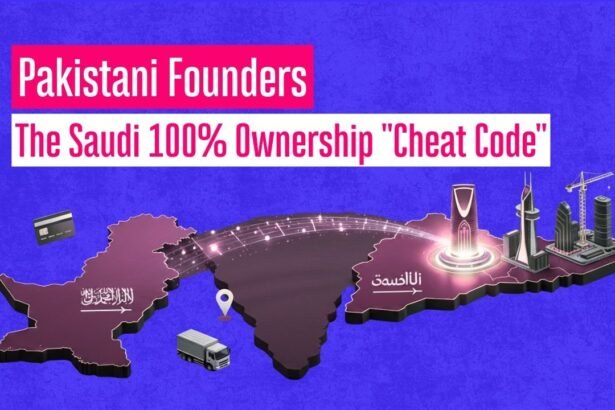
For Pakistani founders facing a capital ceiling at home, the Kingdom isn’t just a market—it’s a multiplier. While Silicon Valley remains the dream, Riyadh has become the reality, offering a rare combination of regulatory agility and sovereign wealth that can turn a local startup into a regional giant overnight. This isn’t about moving your office; it’s about moving your trajectory.
The shift is backed by undeniable liquidity. In the first half of 2025 alone, the Kingdom pumped a record $860 million into its venture ecosystem, cornering 56% of the entire MENA market. For founders navigating a funding winter, this isn’t just a lifeline—it’s a launchpad. The door is wide open, but success is reserved for those who know exactly how to walk through it.
This is your tactical playbook for navigating the Kingdom.
Structuring Your Entity – The “Soft Landing”
The first hurdle is legal incorporation. Historically, this was a maze of red tape and local sponsors. Today, the Kingdom has rolled out the red carpet for Pakistani founders.
- The MISA License: This is your golden ticket. The Ministry of Investment (MISA) offers an Entrepreneurship License specifically for innovative startups. It allows for 100% foreign ownership, meaning you don’t need a local sponsor to hold 51% of your shares. This is critical for keeping your cap table clean for future VC rounds.
- Speed: The initial approval process is now digitized and can take less than 3 hours once you have the required documents.
- The “Flip”: Many founders use a dual structure: a Saudi LLC for operations and revenue, and a holding company (often in ADGM or Riyadh itself under the new Companies Law) for investment.
Pro Tip: Don’t go it alone. MISA has established a dedicated help desk for Pakistani companies that has already facilitated over 100 registrations. Use it.
Finding a Local Partner – Awakening the “Sleeping Capital”
While big VCs get the headlines, the real “sleeping giants” of the Saudi ecosystem are the Family Offices. These conglomerates hold billions in capital and are actively diversifying away from real estate into tech.
For Pakistani founders, a strategic partner here is worth more than just money.
- The “Wasta” Factor: A partnership with a major family group brings influence and validation. It opens doors to government contracts and large enterprise clients that a foreign startup could never crack alone.
- Strategic vs. Financial: Unlike VCs looking for a 10x exit, family offices often look for strategic value. Does your logistics software solve a problem for their massive distribution fleet? Does your prop-tech solution fit their real estate portfolio? Pitch the synergy, not just the valuation.
Sector Opportunities – Where to Win?
Not all sectors are equal. Pakistani founders should target “low hanging fruit”—areas where Saudi demand outstrips local supply and where Pakistan has a comparative advantage.



- Fintech: Saudi Arabia is racing toward a 70% cashless society. Solutions for SME lending, payments, and earned wage access are in high demand. Pakistani fintech ABHI proved this by partnering with local platform TRAY to scale rapidly.
- Construction Tech: With over $1 trillion in giga-projects like NEOM and the Red Sea Project under construction, the demand for software to manage complex workflows is insatiable.
- Logistics: The National Transport and Logistics Strategy aims to make the Kingdom a global hub. Startups that can optimize last-mile delivery or cold chains are solving a massive national pain point.
Cultural Nuance – Trust Over Transactions
The biggest mistake Pakistani founders make is treating Saudi Arabia as a transactional sales territory.
- Presence is Everything: You cannot sell to Riyadh from Lahore. “Fly-in, fly-out” founders rarely succeed. Decision-makers want to see commitment—a physical office and senior leadership on the ground.
- The Majlis Culture: Business often happens in informal settings. Trust is built over tea and late-night dinners, not just in boardrooms. Relationships precede contracts.
- Localization: Hire local. Having Saudi nationals in client-facing roles isn’t just about quotas; it’s about cultural fluency. They navigate the nuances of government relations and business etiquette that an outsider simply can’t.
The Time is Now
The Saudi market offers a once-in-a-generation arbitrage opportunity. Pakistani founders have the talent and the hustle; Saudi Arabia has the capital and the vision. By structuring correctly, partnering strategically, and respecting the culture, you can build a regional champion.
The bridge is built. It’s time to cross it.
Are you ready to make Riyadh your second home?
References
- https://altios.com/publication/ksa-market-entry-etrategy-how-international-companies-can-succeed-in-saudi-arabia/
- https://misa.gov.sa/app/uploads/2025/07/Investor-Guide_12-04.pdf
- https://alraee.com.sa/business-laws-for-pakistani-entrepreneurs-in-saudi-arabia/
- https://www.arabnews.pk/node/2630934/business-economy
- https://motaded.com.sa/misa-license-saudi-arabia-comprehensive-guide
- (https://misa.gov.sa/app/uploads/2025/04/Value-Added-Services-New-Investment-Law-V5-EN.pdf)
- https://nhmanagement.com/set-up-a-foreign-owned-company-in-saudi-arabia/