

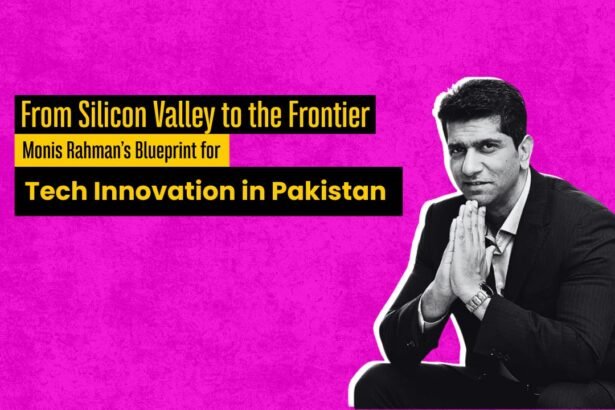
The journey of entrepreneur Monis Rahman offers a compelling blueprint for founders navigating the complexities of emerging markets, specifically Pakistan, demonstrating how HR technology (Rozee.pk) and financial technology (Fintech) are intrinsically linked in paving the way for a digital economy. From our discussion with Monis at Wasssl Podcast …His story spans the rise and crash of the US dot-com era, the slow build of fundamental infrastructure in Pakistan, and the ultimate convergence of AI and finance.
Monis also pursued international growth by targeting Saudi Arabia, recognizing it was the largest online market in the region, historically generating about 60% of revenue for online businesses like Souq. He acquired a loss-making jobs platform there and rebuilt it. Saudi Arabia, however, was a tough market to crack, requiring long sales cycles, relationship building, and even specific Arabic accents to establish credibility. Productivity from the labor market was low, and labor laws were difficult for entrepreneurs. When COVID-19 hit, operations in Saudi Arabia were put into “hibernation” to focus on making Pakistan profitable again…
The Silicon Valley Roots and the Return
Monis Rahman began his career in the US after graduating with a degree in electrical and computer engineering landing a dream job at Intel. Intel, at the time, was at the forefront of computer engineering, making microprocessors and memory chips. Working with highly intelligent people, Monis secured nine patents, primarily related to computer architecture, specializing in algorithms to make chips work faster.
Feeling restless, Monis observed that many smart people worked at Intel their entire lives, yet he believed they could produce far more value outside of being an employee. This period coincided with the first “dot wave,” marked by the creation of companies like Hotmail, Yahoo, and Google. Over a billion dollars was being invested every month into this small area, leading to a euphoric time where consultants quit their jobs and startups launched.
He witnessed both the exciting rise and the eventual crash, learning valuable lessons about which models the market supports and which ideas, though interesting, ultimately fail when played out. In 2003, he moved back to Pakistan. A major factor was the cost of developers in the US, which forced startups to continuously raise more funding—a cycle where salaries were the biggest expense. He recognized that Pakistan had good engineering labor talent. At that time, only about 1.8 million people were using the internet in Pakistan, predominantly from their offices, with traffic dropping almost to zero on weekends. ( Feels like the stone age :D)
The Birth of Rozee.pk and the Payment Problem
Monis first launched Nasim.com, a social networking site targeting the diaspora in North America, the UK, Australia, and Canada, which grew into a cash cow. However, the inspiration for his primary business, Rozee.pk, came from the internal need to hire staff. Having experience hiring online in the US, he started Rozee.pk, which grew very quickly to become the largest jobs platform in the country.
Today, Rozee.pk serves about 65,000 employers and 10 million professionals who have uploaded their CVs, facilitating job applications both within Pakistan and internationally.
Despite its success as a major HR tech platform, Rozee.pk quickly encountered a fundamental challenge common in emerging markets: the payments problem. The company was selling paid job listings for small sums, starting around 800 rupees per job. The sales team had to drive motorcycles to clients to collect cash, feels wild 😀 …leading to heavy logistical burdens and reconciliation issues, and creating suspicion about whether the cash had vanished. Rahman likened the process to running a “rent collection” service.



Monis noted that in emerging markets, “you have to build a little road” before you can move forward, meaning entrepreneurs must build infrastructure to solve their own operational problems.
Paving the Road – The Venture into Fintech with Simsim
To solve the inherent payments problem, He turned to fintech, leveraging a “revolutionary step taken by the State Bank”: the launch of a branchless banking framework. This meant that a bank account could be opened without the customer having to visit a physical bank branch.
Monis partnered with FINA Micro Finance Bank to create FINA and the first telco-agnostic mobile wallet in Pakistan, named Simsim (after the Arabic phrase “open sesame”). The venture, in the early days before an EMI license existed, aimed to solve the payment gap. Simsim was highly innovative:
- They were the first to conduct a QR code transaction at retail.
- They created the first wallet that could be opened solely using an ID card, working closely with the State Bank on the KYC (Know Your Customer) process.
- They launched Payroll Plus, a payroll processing platform that gave employees Simsim wallets and allowed them to take loans against their salaries, predating the wider concept of Earned Wage Access (EWA).
The team even experimented with credit scoring professionals instantly using Rozee data to give the first loans on a smartphone.
The High Cost of Innovation and Unexpected Headwinds
The fintech venture, however, faced major structural challenges typical of capital-intensive startups in emerging markets.
1. Capital Intensity and Behavioral Change: Rahman learned that launching a mobile wallet required significant marketing expenditure to induce a radical behavioral change—getting people to install the app, input their ID, and figure out how to fund and use the wallet. The team had raised about a million dollars, but quickly realized they needed between $50 million and $100 million for user acquisition. Telcos were far more effective at user acquisition because they had established customer bases and could use incentives like airtime, although those users were often inactive.
2. Partnership Pitfalls: FINA Micro Finance Bank was part of a larger international company, and the local operations were generating about 80% of the profits for the global network, acting as an “ATM machine” to pay for global overhead. When the bank’s global stakeholders became impatient about the lack of immediate profit from the wallet—despite technological progress—they cut off marketing investments. Rahman realized that partnering with giants exposes entrepreneurs to unexpected headwinds, as corporate objectives and personnel change, stressing the need to always have options.
3. Operational Nuances and Market Timing: Rahman later reflected that many innovations within Simsim were “too early”. Furthermore, he learned that he personally struggled to build complex startup companies without being directly and operationally involved in the detailed nuances. When COVID-19 hit, FINA had to halt its employee payroll processing portfolio—which was thriving—out of fear that layoffs would prevent loan repayments.
Eventually, the VC market collapsed globally, and a committed investor backed out late, causing financial stress. Differences arose within the management and investors became nervous. To remain viable, an exit was sought, and the FINA EMI license was sold to OP E.
Market – Reality Check & Expansion Lessons
The attempt to scale Rozee.pk internationally yielded crucial, expensive lessons about market concentration in Pakistan.
Inspired by the success of companies in India, where adding a city led to massive growth, Monis decided to replicate this playbook by opening sales offices in nine cities in Pakistan. After raising funding, running TV ads, and building out the sales team, revenue increased by only 10%, while the burn rate increased fourfold. ( Not good news, especially in an emerging market) The realization was that, unlike India where small cities might have the GDP of Pakistan’s largest cities, the economic “juice” in Pakistan is concentrated in just a few major cities.
The AI-First Transformation and HR-Fintech Convergence
Monis now sees Pakistan’s fintech ecosystem as a “Disneyland for entrepreneurs,” with all the necessary technological rails in place. Regulators have been responsive, launching frameworks like the EMI license, regulatory sandboxes (P2P crowdfunding), and the national instant payment system, RAAST, which is viewed as a “hockey stick inflection point”.
Rozee.pk has been relaunched as an “AI-first” platform, potentially the first recruiting platform globally to fully transition. This model leverages semantic and contextual AI to overhaul the employment process, including automatic matching, job description generation, and assessments. The accuracy of the job matching algorithm has dramatically improved from about 60% to 95-98%, surpassing human recruiters.
A key innovation is the use of agentic AI bots (Aisha, Ahmed, Hina) which act as AI-based recruitment consultants on WhatsApp. These bots engage in about 3,000 conversations daily with job seekers, patiently answering questions and explaining why certain jobs are a good fit. This implementation saw the conversion rate for job matching alerts skyrocket from 5% (via email) to 22.5%. The intellectual property from this development has been spun out into a Singaporean company called Recruit AI, demonstrating that AI built in Pakistan can leverage a cost arbitrage and compete globally.
Crucially, AI acts as a great equalizer. The conversational Urdu voice-note interfaces allow the platform to serve the 40 million blue-collar workers (like carpenters and mechanics) who were previously excluded from sophisticated English interfaces. This massive digitization allows the company to collect data on these workers and offer incremental financial services, such as loans, savings advice (like halal mutual funds or gold), and capital for growth, creating an exciting flywheel.
Dukan – The Licensed-Light Fintech Enabler
Applying the lessons learned from the capital-intensive Simsim and B2B models, Rahman launched Dukan, a digital banking platform for undocumented retail merchants. The core thesis is that B2B platforms only work when combined with fintech, moving away from models that require buying inventory, warehousing, and managing large delivery fleets.
Dukan operates on a “licensed light” approach, focusing on being an enabling platform that connects incumbent players (like distributors) to the existing ecosystem, rather than replacing them. Dukan helps small, undocumented merchants come online by instantly generating a unified QR code to accept payments, simply requiring their ID card and a selfie. ( KYC) The service also enables merchants to sell airtime and process bill payments.
The true financial opportunity lies in lending, by integrating fintech and using incoming and outgoing transaction data to credit score the merchants. This digital transformation is inevitably leading to the “whitening” of the economy; the convenience and benefits of digital finance, such as access to credit, make participation compulsory, even for the gray and black economies.
What is in it for MENA Entrepreneurs ?
Monis Rahman’s decades-long experience in Pakistan provides clear guidance for new entrepreneurs in emerging markets:
1. Cultivate Resilience and Faith: Pakistan is a tough market to crack, and success takes “a lot longer than you think”. Resilience and staying power are essential.
2. Avoid High Valuations: Do not get trapped into raising money at a high valuation that cannot be justified by the income generated in the Pakistani market, a common pitfall for many startups.
3. Build Organically and Autonomously: Try to build the business organically with a small seed round, securing a paying customer first, before raising large sums. Strive to be as autonomous as possible to maintain the creativity needed to experiment and backtrack, which is essential in a market where problems haven’t been solved before.
4. Operational Involvement is Key: It is difficult to build startup companies without being directly and operationally involved in the detailed nuances.
5. Leverage AI for Inclusion: Use AI not just for efficiency (like high-accuracy matching), but as a “great equalizer” to access the massive blue-collar workforce previously excluded by complex interfaces. AI allows rapid creation of incremental value, giving local entrepreneurs a significant cost arbitrage advantage over Western companies.
To concluded, the current period is the most exciting because all the “Lego blocks are in place” for accelerated growth, allowing entrepreneurs to finally reap the rewards of the infrastructure built over the last two decades