

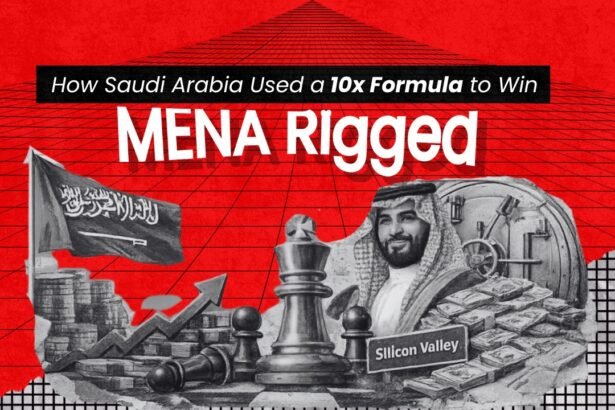
If you want to win a game, you can practice for years. Or, you can redesign the stadium, write the rulebook, and own the bank that prints the prize money. In the MENA startup arena, Saudi Arabia chose option two.
Over the last decade, the Kingdom didn’t just enter the regional startup race. They fundamentally engineered the track to ensure they would win. This wasn’t accidental growth. It was a calculated, sovereign-backed “10x Formula” designed to compress fifty years of economic evolution into ten.
The results are now undeniable. In the first half of 2025, Saudi Arabia captured 56% of all venture capital deployed across the entire MENA region. They logged a record-breaking $860 million in funding, defying a global slowdown.
Here is how they engineered this dominance and why the rest of MENA is playing catch-up.
The Sovereign Multiplier – Turning $1 into $10
The core of the “10x Formula” is a financial mechanism known as the “sovereign multiplier.“
Most governments try to support startups with grants. Saudi Arabia took a different approach. They used sovereign wealth to “prime the pump” for private investors.
Entities like the Saudi Venture Capital Company (SVC) and Jada Fund of Funds act as market makers. They don’t just invest in startups; they invest in investors. By backing VC funds, they lower the risk for the private sector.
The math is simple but effective.


- The Input – For every $1 the government invests.
- The Output – They stimulate roughly $4 to $10 of total ecosystem value.
- The Result – A 21-fold increase in venture funding between 2018 and 2023.
This effectively “rigs” the market in favor of growth. It creates a safety net that encourages local family offices to unlock their massive cash reserves.
The Private Sector Pivot
For years, the story was all about the Public Investment Fund (PIF) spending billions. Now, the script is flipping.
The “10x Formula” is entering a new phase. The government is starting to ease off the gas to let the private sector drive.
Recent reports suggest the sovereign wealth fund is being urged to moderate domestic project spending. The goal is to clear the lane for private companies to take over the value chains the state has seeded. This shift is critical for long-term sustainability. It proves the market isn’t just a government project; it’s a real economy.
Regulatory “Cheat Codes” To Overtake MENA
Money is useless if the laws are broken.
Saudi Arabia realized that to dominate MENA, they needed to rewrite their entire corporate operating system. They didn’t just tweak laws; they overhauled them.
- 100% Foreign Ownership: Removed the need for local sponsors.
- New Companies Law: Introduced flexible structures like the Simplified Joint Stock Company (SJSC).
- Bankruptcy Laws: Modernized to allow for safe failure and restructuring.
These changes function like “cheat codes” for speed. They remove the friction that plagues other MENA markets. Founders can now incorporate faster, raise money easier, and protect their rights better than ever before.
Beyond Tech – The Industrial Engine
While apps get the headlines, the “10x Formula” is heavily applied to heavy industry.
Private Equity (PE) in the Kingdom has seen an 8-fold boom, hitting $4 billion in 2023. Unlike Venture Capital, which hunts for unicorns, PE hunts for workhorses.
- Manufacturing: Captures 46% of PE investment.
- Logistics: Driving the physical infrastructure of Vision 2030.
- Consolidation: Family businesses are merging to form corporate giants.
This industrial base provides the physical backbone that digital startups need to scale. It creates a complete ecosystem where software optimizes hardware, and hardware fuels software.
Financial Sustainability – The Debt Strategy
How do you fund a trillion-dollar transformation without going broke? You get smart about debt.
Saudi Arabia has sophisticated its approach to sovereign debt to ensure the spending spree doesn’t become a liability. They have diversified their funding sources and improved their credit ratings.
This sustainable debt strategy is the invisible pillar of the “10x Formula.” It ensures the government can keep the lights on and the capital flowing, even if oil prices fluctuate. It provides the stability international investors crave.
The “Super Founder” Effect
Capital needs capable hands.
The “10x Formula” has attracted a specific breed of entrepreneur. Data shows that the average top-tier Saudi founder isn’t a college kid.
- Experience: 36% have over 10 years of professional experience.
- Education: 59% hold technical STEM degrees.
- Background: Many come from giants like Aramco, McKinsey, or Microsoft.
These “Super Founders” reduce execution risk. They know how to navigate the local market while executing at global standards. They are the human multiplier effect.
Global Validation and Economic Gravity
The world has noticed.
Institutions like the IMF have validated the Kingdom’s non-oil growth trajectory. The economic transformation is no longer a projection; it is a measurable reality in GDP data.
Furthermore, political analyses confirm that this economic restructuring is central to the Kingdom’s new geopolitical power. By owning the MENA economic narrative, Saudi Arabia secures its political future.
The Engine is Running
Saudi Arabia didn’t “rig” the market in a nefarious way. They rigged it by building a better engine than anyone else.
They combined sovereign capital, agile regulation, and industrial depth to create a market that is structurally superior to its neighbors. With 56% of regional funding now flowing to Riyadh, the center of gravity has permanently shifted.
The ecosystem is flush with cash, powered by experienced talent, and supported by a government willing to rewrite the rules for growth.
The Saudi model offers a stark lesson for neighboring economies: hope is not a strategy, but architecture is. Instead of waiting for organic growth, emerging markets can replicate this “sovereign multiplier” by using state capital to de-risk private entry rather than crowding it out. For nations across the MENA region and beyond, the blueprint is now clear—align regulation with capital, professionalize the founder class, and treat the ecosystem as a product to be engineered, not a garden to be watered. The “10x Formula” isn’t exclusive to the Kingdom; it is a proven roadmap for any nation brave enough to stop playing by old rules and start building their own engine.
The question for the rest of the region is no longer how to beat Saudi Arabia, but how to integrate with the machine they have built?
References
Medium (Innovation Sovereignty Analysis): https://medium.com/@tarifabeach/capital-with-consequence-how-saudi-arabias-pif-is-rewriting-the-future-of-sovereign-investment-bc3b65e6868e
The Arab Weekly (Private Sector Shift): https://thearabweekly.com/saudi-sovereign-wealth-fund-urged-ease-domestic-spending-make-way-private-sector
Arab News (Economic Updates): https://www.arabnews.pk/node/2617425/business-economy
Ehata Financial (Sovereign Debt Strategy): https://ehatafinancial.com.sa/portfolio/saudi-arabias-journey-to-sustainable-sovereign-debt/
SWP Berlin (Political Economy Analysis): https://www.swp-berlin.org/10.18449/2019RP08/
IMF eLibrary (Economic Transformation Data): https://www.elibrary.imf.org/view/journals/002/2024/281/article-A001-en.xml
Lexology (Legal & Regulatory Reforms): https://www.lexology.com/library/detail.aspx?g=5cc1eed2-c339-4f1f-a55a-19cb5be51813
Saudi Venture Capital (SVC) Reports: https://svc.com.sa/en/reports/
MAGNiTT (Data Source for H1 2025): https://magnitt.com/research/H1-2025-Saudi-Arabia-Venture-Capital-Report-51001